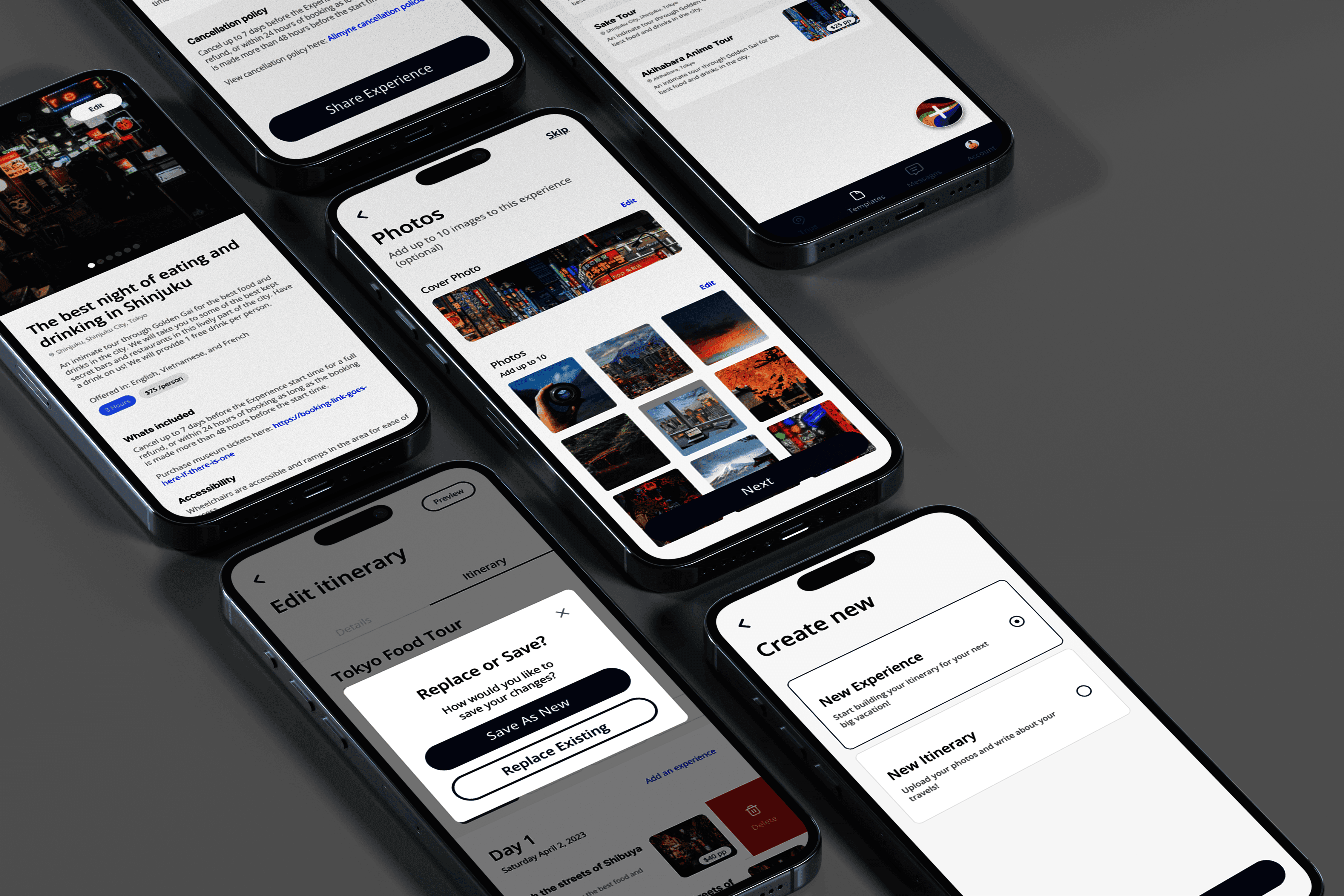
An innovative mobile app poised to revolutionize healthcare, providing patients with a streamlined platform to connect with healthcare providers effortlessly. With features including virtual consultations, appointment scheduling, prescription management, and secure health record storage, all conveniently accessible from the palm of the user's hand.
www.baker-health.com
Role
Product Designer
Team
Product Designer x1
Software Engineers x2
Contributions
Research, information architecture, prototyping, design system contributions, and user testing.
Timeline
6 months
When
2023 - 2024
Booking a doctor's appointment is the core function of any healthcare app. However, Baker Health's outdated and clunky booking system created unnecessary friction and frustration, failing to meet modern standards for speed and simplicity. This resulted in low user satisfaction, costly support calls, and ultimately, decreased app adoption.
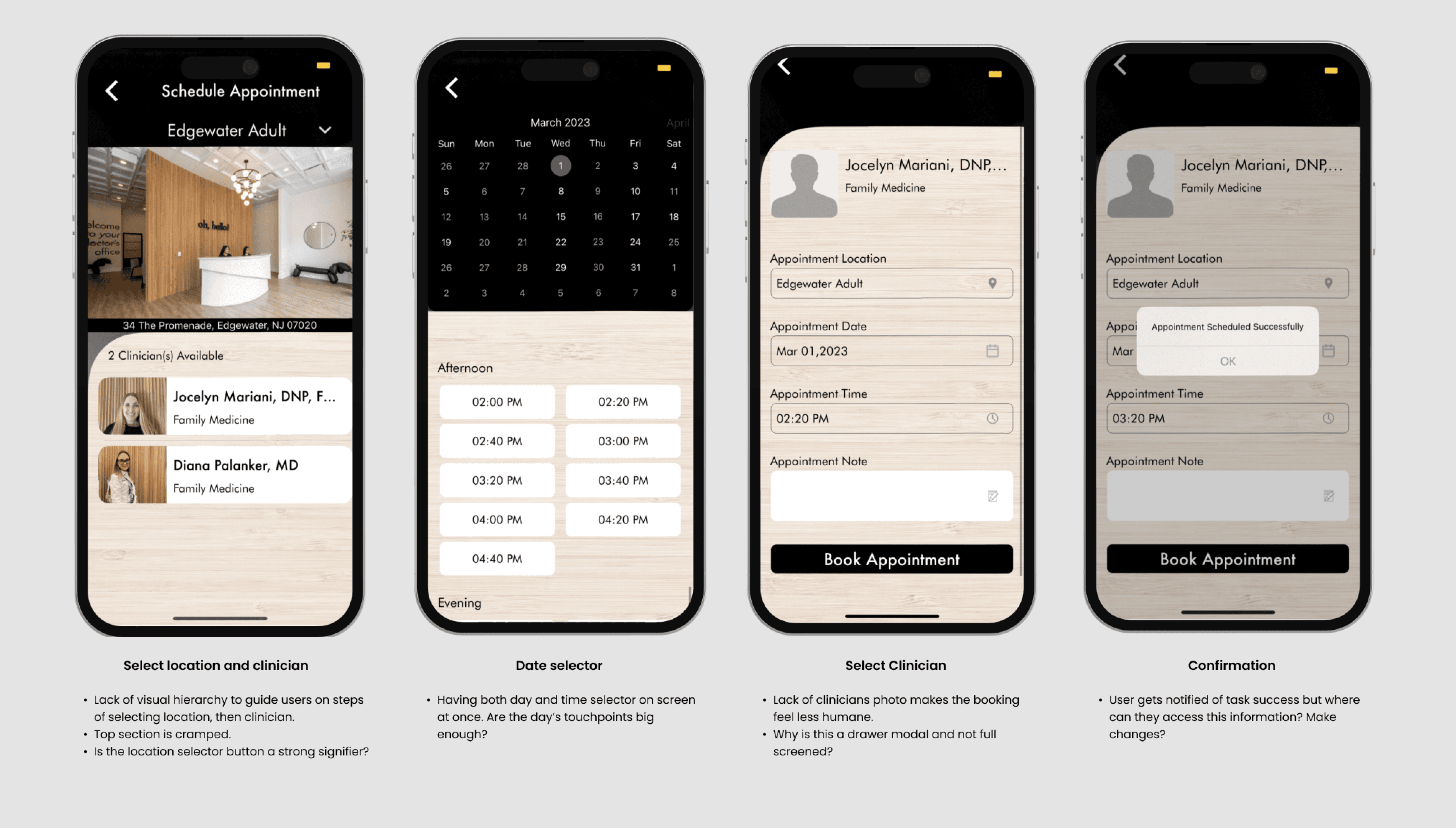
The pre-redesign Baker Health App suffered from a complex and unintuitive layout, leading to user confusion and difficulty accessing critical functions. This frustration was a primary barrier to a positive patient experience.
My process started with a detailed usability review to pinpoint the most urgent areas for improvement, which directly informed the redesign strategy.
OBJECTIVE 1
Increase user satisfaction
In today’s heavily competitive tech market, user’s expectations have continuously grown with constant exposure to high profile apps. How can we meet the modern user’s expectations of how an app should function.
OBJECTIVE 2
Increase adoption rate
There’s an app for everything nowadays. How can we leverage this feature to help users feel they truly need this app to solve their needs?
I conducted user interviews with several participants to gain a deeper understanding of their goals, use cases, and primary pain points with the existing booking process.
PAIN POINTS
Long wait to see a doctor
Whether its trying to book an appointment, or sitting in the clinic. Users reported difficulty seeking help.
PAIN POINTS
Poor navigation and design
The interface is cluttered or outdated, making it hard for users to find key features like appointment scheduling or clinician details
PAIN POINTS
Feeling disconnected and inhumane
The booking process often feels impersonal and unclear, leaving users with a sense of detachment and uncertainty. This lack of warmth and guidance makes the experience feel transactional rather than caring, which can reduce user trust and satisfaction.
PAIN POINTS
Difficulty rescheduling or canceling
The app lacks flexibility in modifying appointments, forcing users to call the office instead of managing their bookings through the app.

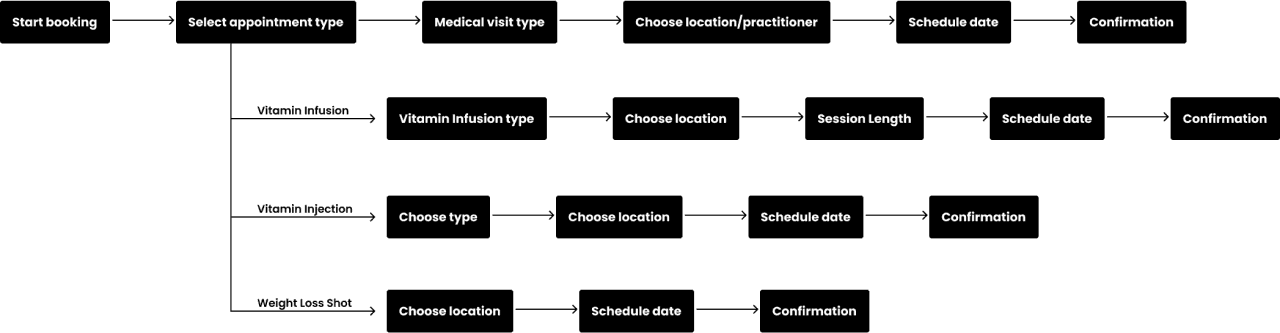
The redesign expanded to include new service offerings: vitamin infusions, injections, and weight loss shots. This required me to evolve a simple doctor-booking flow into a more complex system capable of handling multiple appointment pathways.
The goal was to streamline the booking process while accommodating new service types.
I mapped this out with clear user flows to visualize the logic and collaborated with engineering to ensure the proposed structure was technically feasible and efficient to build.
High-Fi Mockups
Seeing a Practitioner
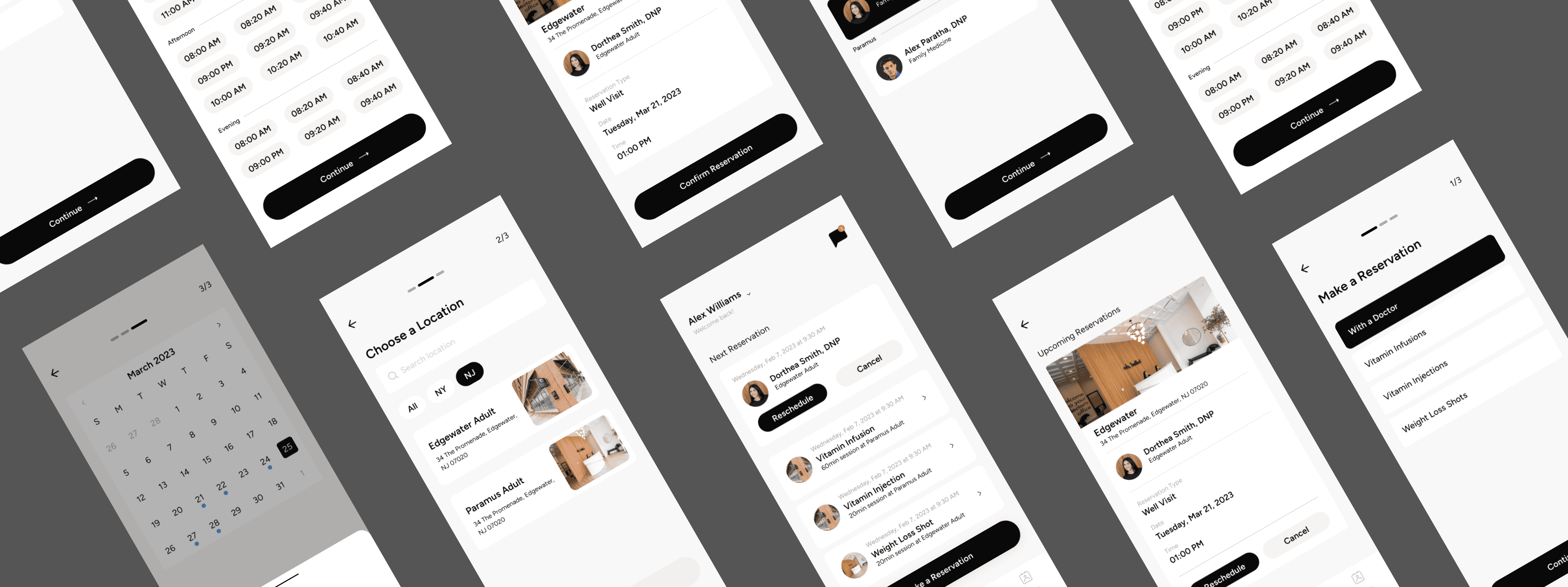
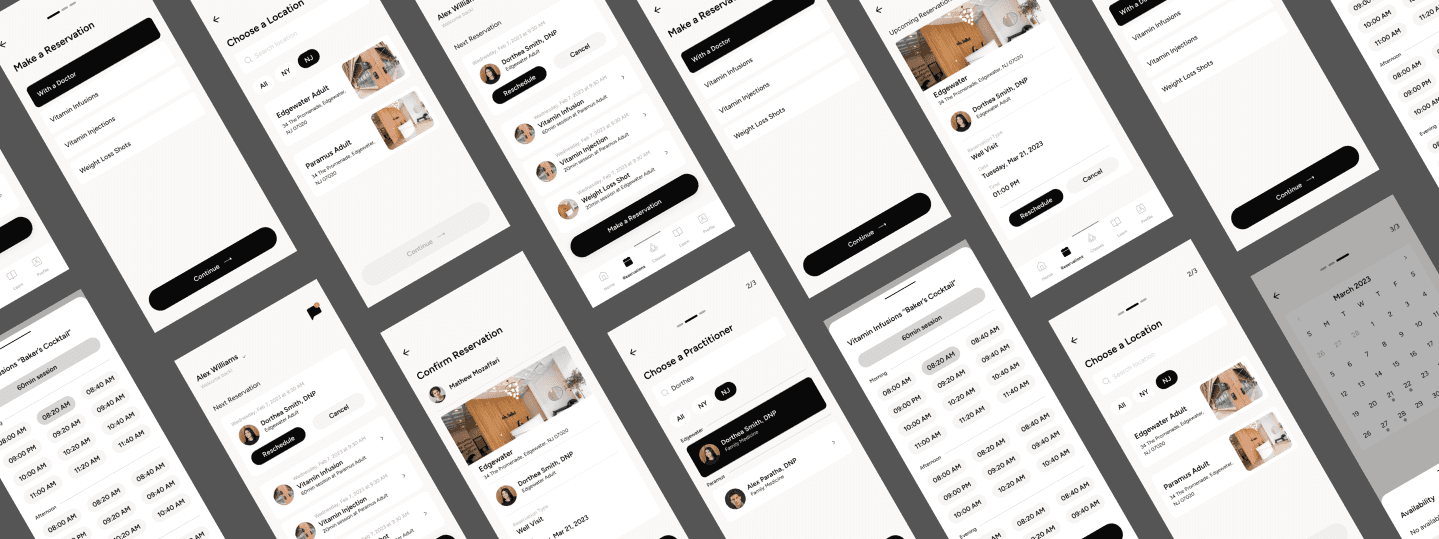
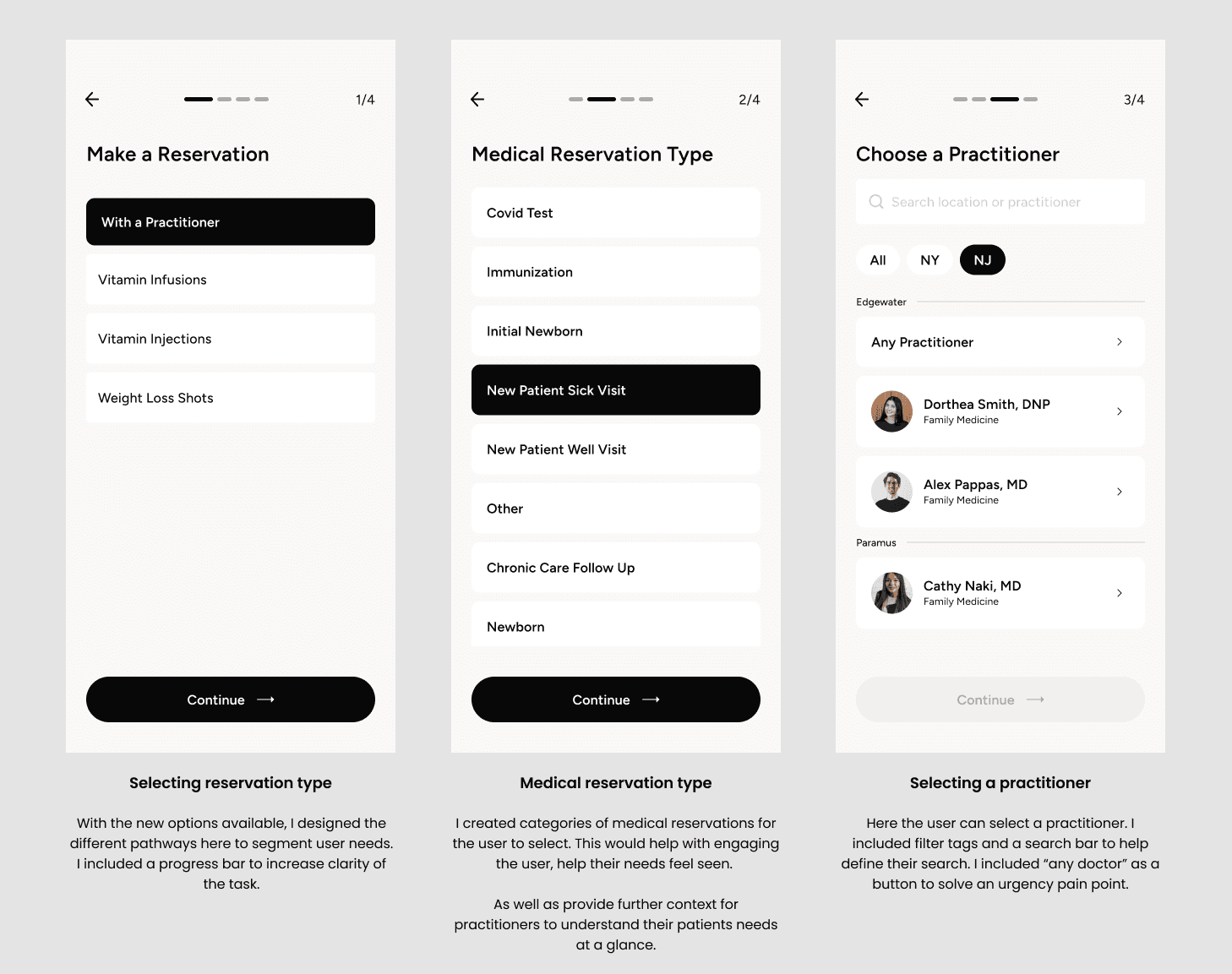
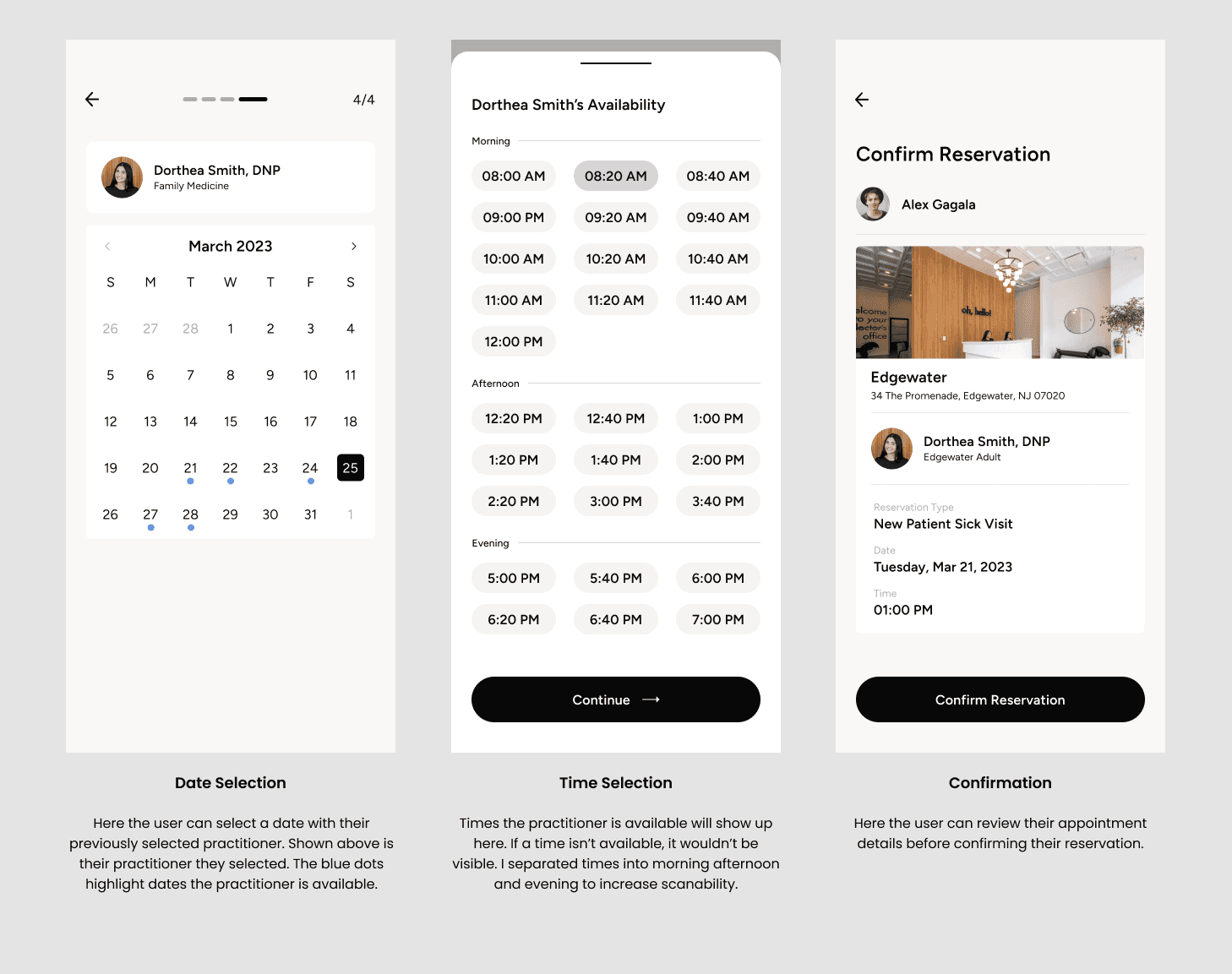
After conducting thorough research and understanding the technical architecture, I developed a high-fidelity, interactive prototype to test and validate the proposed user flow.
The screens below detail the steps a user takes to complete a booking for a practitioner. To make the process feel more humane, I opted for the naming convention of 'reservation' rather than 'appointment,' a subtle yet intentional copywriting choice that creates a more welcoming experience.
High-Fi Mockups
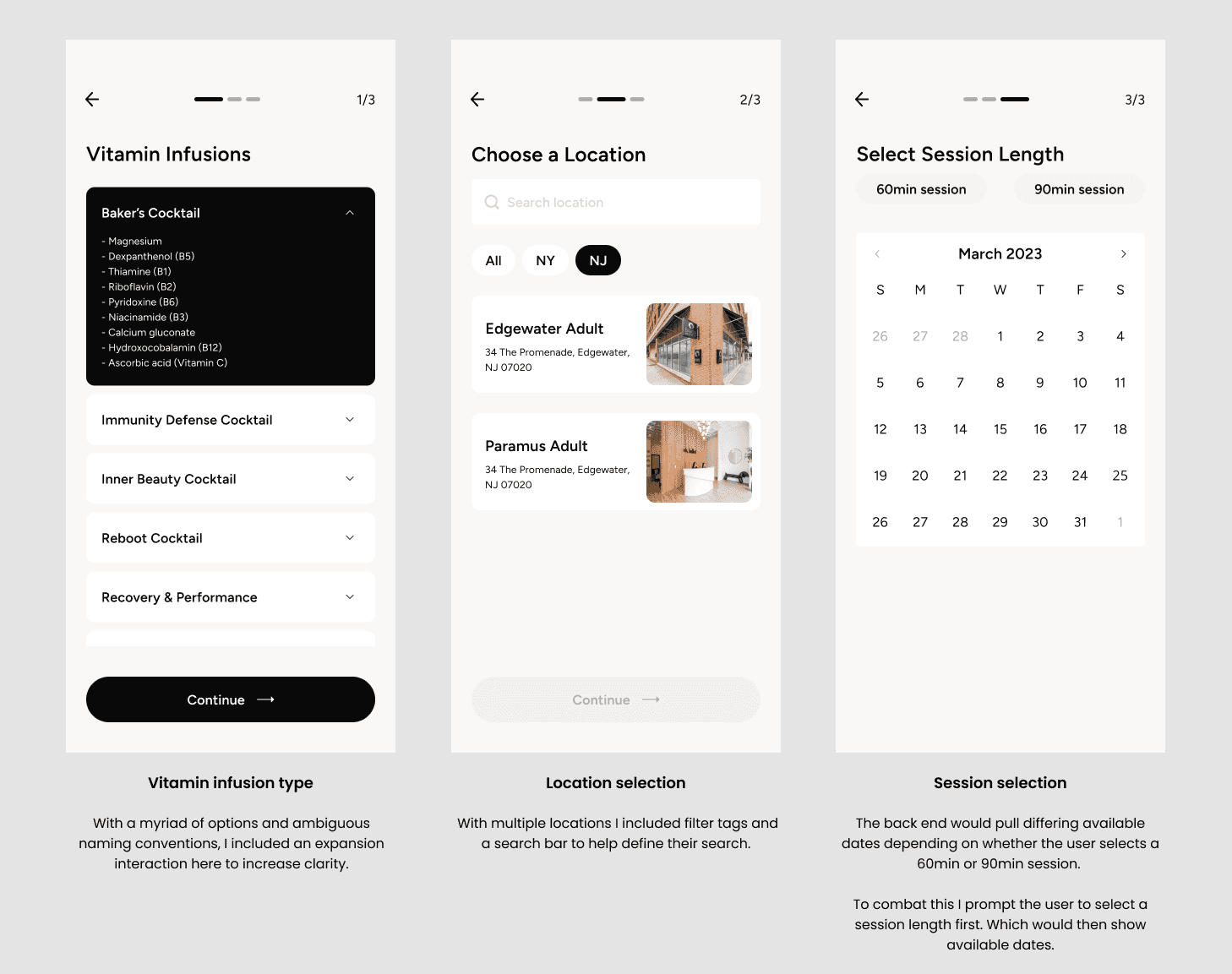
To maintain user familiarity and design efficiency, I applied the foundational structure of the medical booking flow to the vitamin infusion process. I then introduced tailored components for its unique selection steps, such as infusion type, location, and session length, maximizing reuse from the existing design system to ensure consistency and accelerate development.
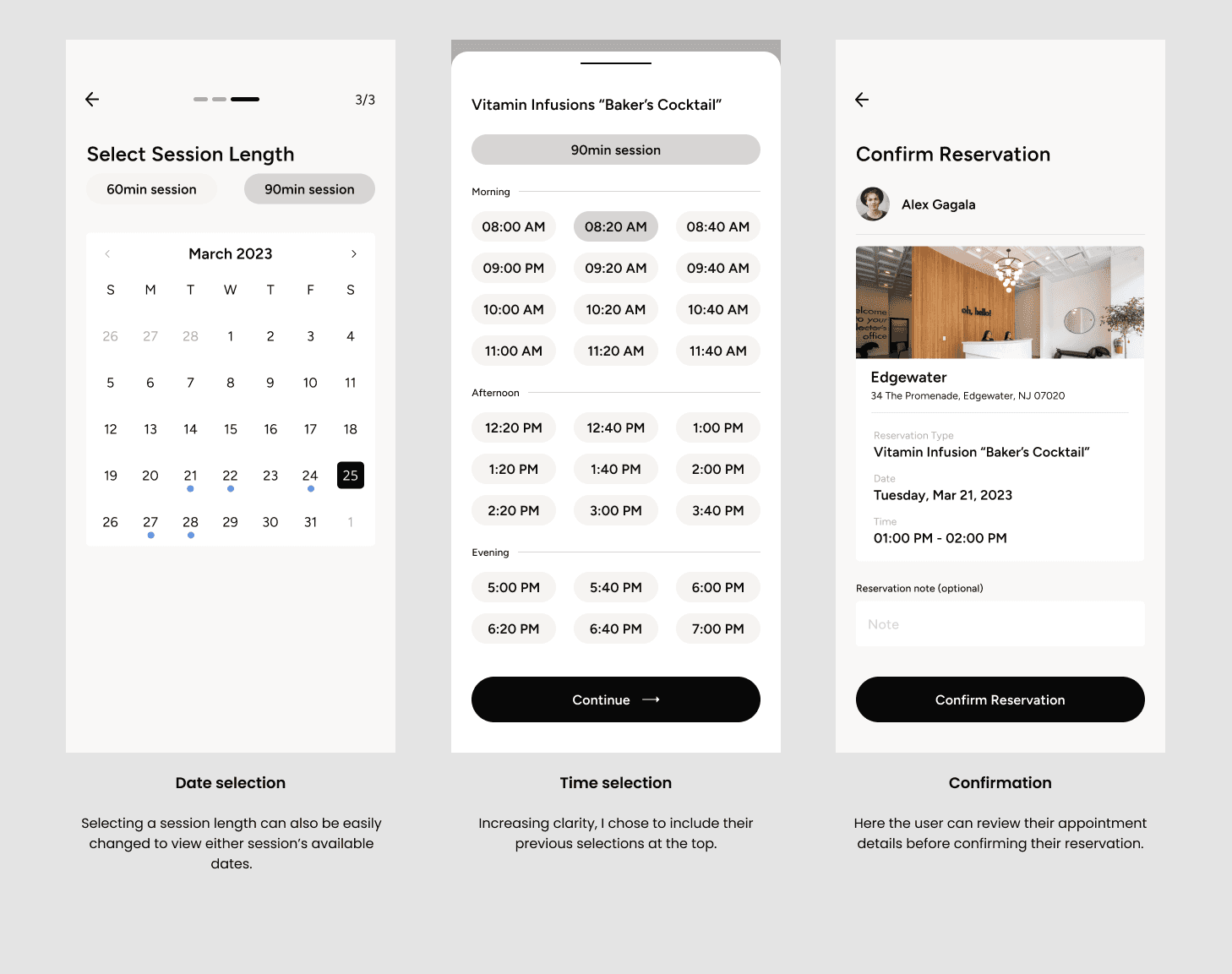
High-Fi Mockups
Addressing the critical lack of flexibility meant designing beyond the initial booking.
A key part of the new experience was creating a transparent system where users are confidently notified of a successful booking and are given a centralized area to manage them. Effectively eliminating the need to call the office for simple changes.
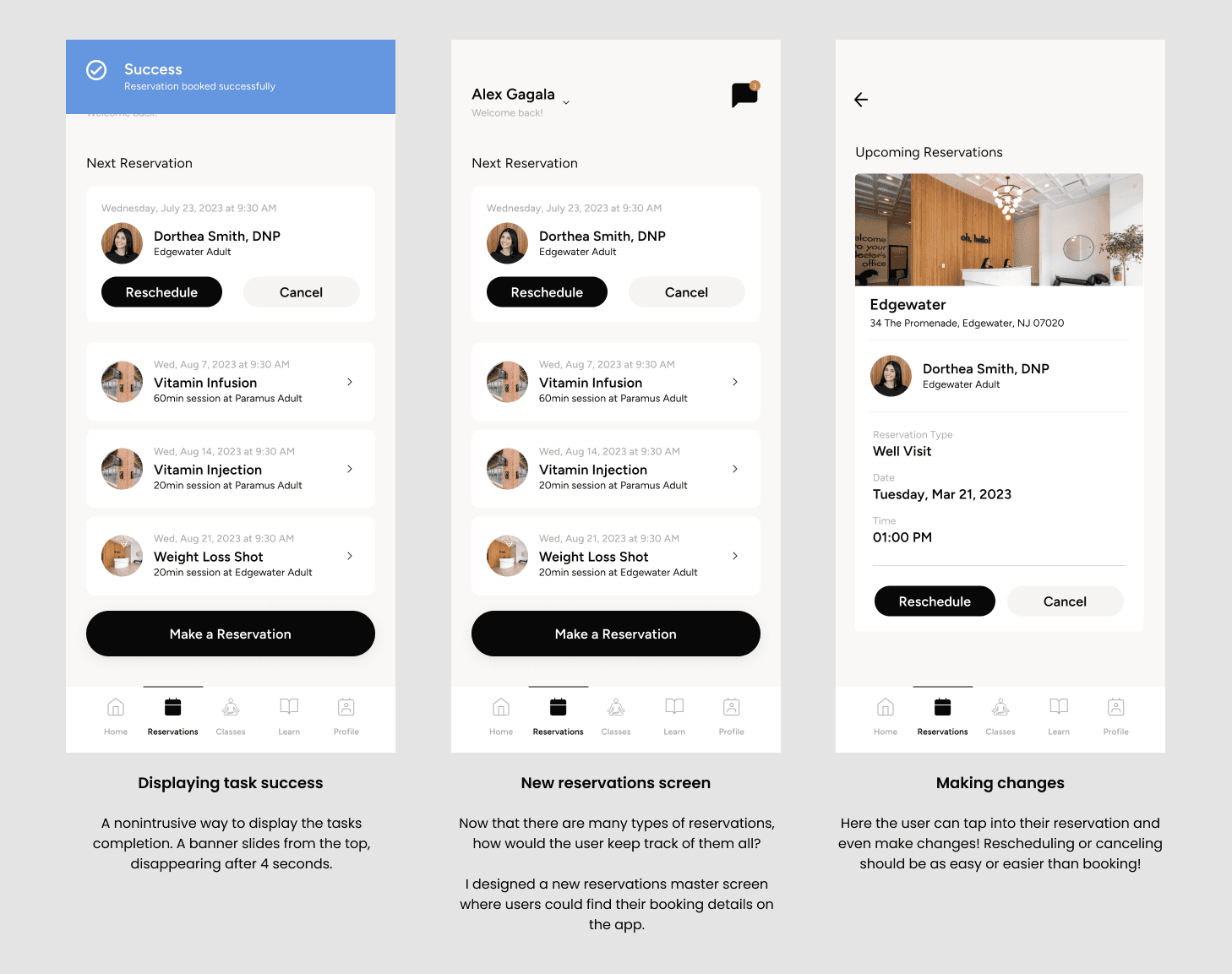
What’s design without testing them for proof? I conducted usability testing with potential users. Participants were asked to walk through the prototype and complete core tasks, such as booking a reservation.
After each session, I gathered feedback on the experience's intuitiveness and asked if they could see themselves using the app regularly.
TEST RESULTS
80% User satisfaction
TEST RESULTS
90% Task completion rate
TEST RESULTS
80% Of users say they would keep the app
“The process feels clear and I have a sense of what to do. Overall, it feels organized and concise. I can’t seem to find anything I dislike.”
- Comment from one of the users
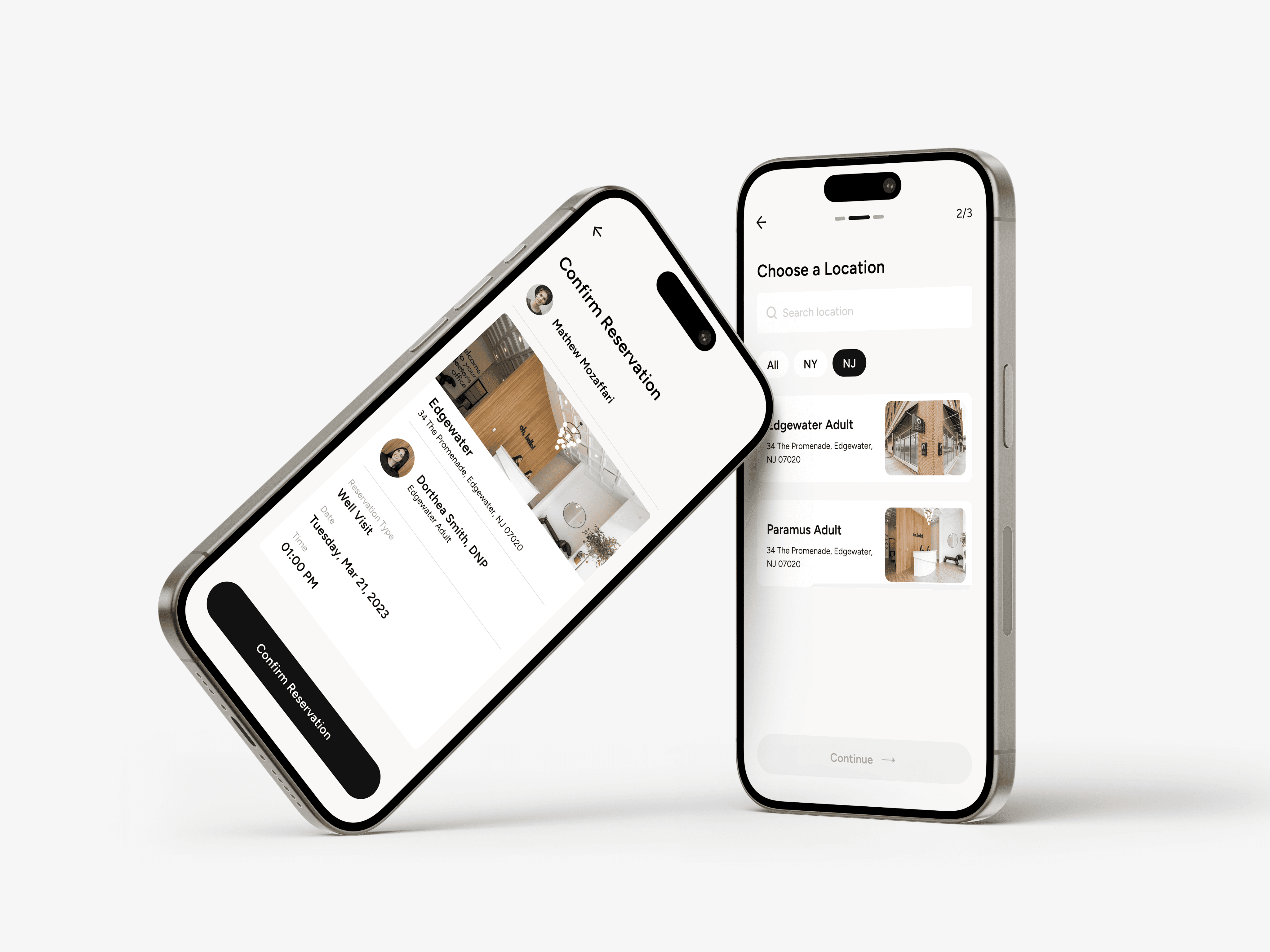
Beyond the booking flow, I played a key role in the holistic redesign of the app, designing experiences for member registration, class scheduling, and patient-provider chat. The impact of these efforts was measured through a set of post-launch metrics focused on user engagement and efficiency:
41%
32%
5,000
Future iterations will focus on continuous improvement based on user data and feedback. Priorities include optimizing conversion rates for the new booking flows and scaling the design system to accommodate new services seamlessly.